Dec
08
2014

OSI
 We have another call for papers to share, this time for the 7th annual workshop of the International Society for the History and Theory of Intellectual Property (ISHTIP), which will take place from Joly 22-24, 2015 at the University of Pennsylvania. They seek a broad representation of international scholars as well as scholars from across the disciplines. Papers may concern trademark, patent, copyright, or related rights, including confidentiality and trade secrecy, and they may be historical or address current issues from a theoretically-informed perspective. Both established and junior scholars are encouraged to submit abstracts. The deadline for application is January 15, 2015.
We think this workshop may be of interest to many OSI alumni. You can find more information at http://www.ishtip.org/ and in the official Call for PapersISHTIP CFP final .
Aug
09
2014
OSI
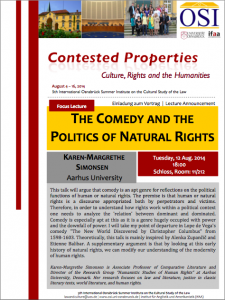 We are happy to announce our next focus lecture within the context of this year’s Osnabrück Summer Institute on the Cultural Study of the Law. Prof. Karen-Margrethe Simonsen will talk about “The Comedy and the Politics of Natural Rights” on Tuesday, 12 August 2014, at 6 pm in room 11/212.
Karen-Margrethe Simonsen is Associate Professor of Comparative Literature and Director of the Research Group “Humanistic Studies of Human Rights” at Aarhus University, Denmark. Her research focuses on law and literature, justice in classic literary texts, world literature, and human rights.
Abstract: This talk will argue that comedy is an apt genre for reflections on the political functions of human or natural rights. The premise is that human or natural rights is a discourse appropriated both by perpetrators and victims. Therefore, in order to understand how rights work within a political context one needs to analyze the ‘relation’ between dominant and dominated. Comedy is especially apt at this as it is a genre hugely occupied with power and the downfall of power. I will take my point of departure in Lope de Vega’s comedy “The New World Discovered by Christopher Columbus” from 1598-1603. Theoretically, this talk is mainly inspired by Alenka Zupančič and Etienne Balibar. A supplementary argument is that by looking at this early history of natural rights, we can modify our understanding of the modernity of human rights.